
Multisizer 4e Contador Coulter
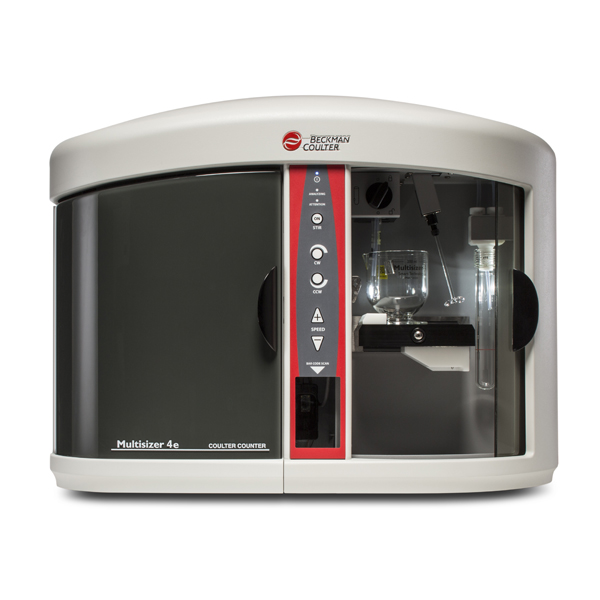
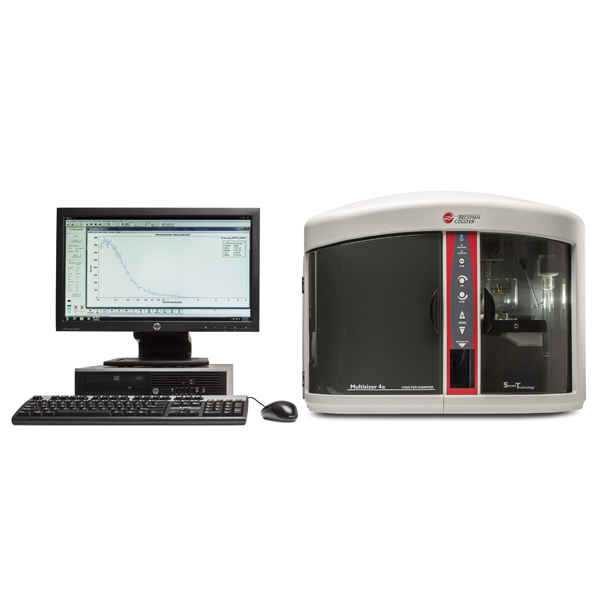
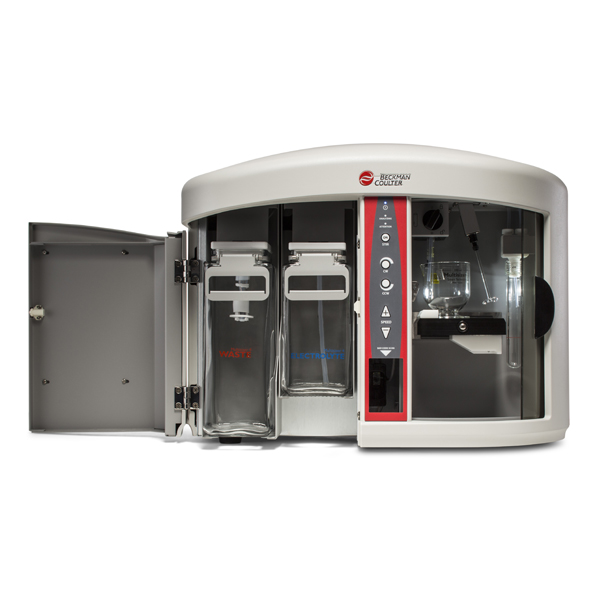
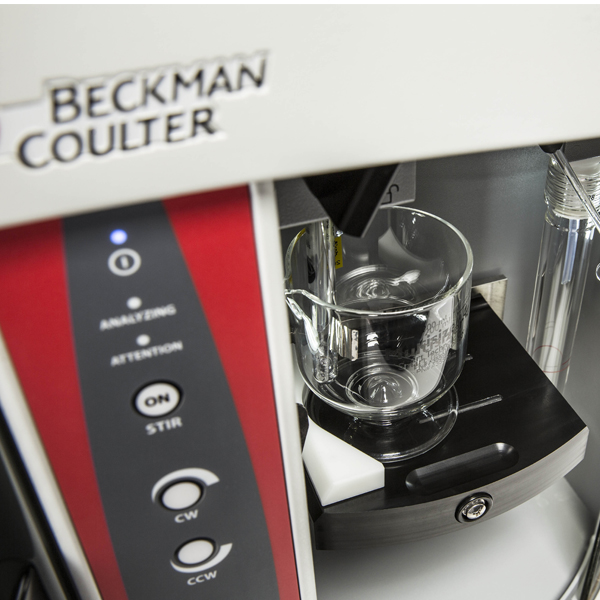
O Multisizer 4e Contador Coulter é um sistema de contagem e caracterização de partículas altamente versátil.
Ele utiliza o princípio Coulter para detectar partículas através de detecção de zona elétrica, independente da natureza ou propriedade óticas da partícula. Isto torna o a ferramenta ideal para detectar e contar uma grande variedade de partículas, como por exemplo:
- Células mamíferas
- Bacteria
- Levedura
- Abrasivos
- Partículas de toner
- Agregados celulares
- Esferóides
- Agregados protéicos grandes
Documentação e Notas de Aplicação




Características
Versatilidade
- Abertura com tamanhos de 10 µm - 2000 µm em diâmetro para necessidades atuais e futuras
- Múltiplas opções de abertura & capacidade de sobreposição de dados para análise de amostras complexas em uma ampla variedade de distribuição de dimensionamento de partículas
Detecção de Amostra
- Analise materiais em solventes aquosos e não aquosos
- Ideal para amostras biológicas ou não biológicas
- Detecta partículas independente do tipo de material ou propriedades óticas
Contagem de Partículas Rápida
- Taxa de amostragem tipicamente até 10,000 contagens por segundo
- Detecção e contagem de partículas de 0.2 µm- 1600 µm em diâmetro
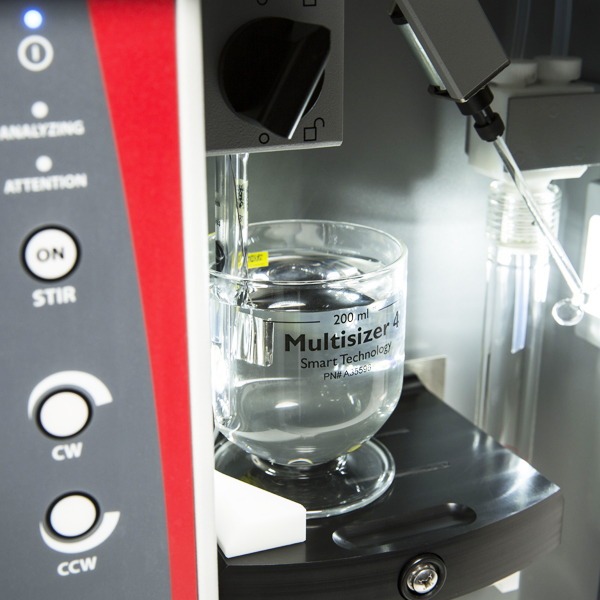
- Volumes de amostra tão pequenos quanto 5 mL
Gestão de Dados
- Dados de pulso digital podem ser armazenados & reanalisados conforme necessário
- Software para controle de auditoria & segurança em conformidade com a CFR 21 Parte 11
- Variedade de esferas de calibração & controles de validação V-check
Explore Multisizer 4e Models
Documentos técnicos
Multisizer 4e Particle Analyzer
What is the Coulter principle for particle analysis?
The Coulter principle is a widely used method for particle size and count analysis based on electrical resistance. It works by suspending particles in a conductive liquid and passing them one by one through a small aperture with an electrical current applied.
When a particle passes through the aperture, it displaces its own volume of electrolyte, causing a momentary change in electrical impedance. This change is directly proportional to the particle’s volume, allowing precise measurement of particle size and concentration.
The Coulter principle is commonly used in particle characterization, cell counting (e.g., blood cells), pharmaceuticals, biotechnology, and industrial quality control because it provides accurate, reproducible, and number-based particle measurements.
What's a good way to measure particle size distribution?
A reliable way to measure particle size distribution is Electrical Sensing Zone (ESZ) analysis, also known as the Coulter principle. This method measures particles individually as they pass through a small aperture, delivering high-resolution, number-based particle size distributions across a wide size range.
Instruments like the Multisizer 4e Particle Analyzer apply this technique to provide accurate, reproducible particle sizing and counting for applications in pharmaceuticals, biotechnology, industrial materials, and research. The Multisizer 4e Particle Analyzer is especially effective when precise control, traceability, and true particle-by-particle measurement are required—making it a gold standard for particle characterization.
What is the difference between a Coulter counter and flow cytometry for cell counting?
A Coulter counter counts and sizes cells using the Coulter principle (Electrical Sensing Zone) by measuring changes in electrical impedance as each cell passes through a small aperture. This provides accurate, label-free total cell counts and true cell volume measurements, independent of cell color, shape, or optical properties.
Flow cytometry, by contrast, counts cells using light scatter and fluorescence as cells pass through a laser. It enables multiparametric biological analysis (e.g., surface markers, viability, phenotype) but typically requires fluorescent labeling and is more sensitive to optical and staining variability.
How to count particles regardless of their shape or color?
The most effective way to count particles regardless of shape, color, or optical properties is by using Electrical Sensing Zone (ESZ) technology, also known as the Coulter principle. This method counts particles individually by measuring changes in electrical impedance as each particle passes through a small aperture filled with a conductive liquid.
Because the signal is based on particle volume, not light scattering or imaging, ESZ analysis delivers accurate, label-free particle counting that is independent of particle shape, transparency, refractive index, or color. This makes it ideal for heterogeneous samples in biotechnology, pharmaceuticals, industrial materials, and quality control.
Instruments such as the Multisizer 4e Particle Analyzer apply this technology to provide precise, reproducible particle counts and size distributions across a wide size range.
